

Relocating or refurbishing a corporate workspace is one of the most significant capital expenditures a business will undertake. Beyond the aesthetic appeal, a successful office fit out serves as a catalyst for cultural change, operational efficiency, and long-term talent retention. This guide provides a technical roadmap for project managers and facility directors to navigate the transition from a shell-and-core or Category A space to a fully functional, high-performance work environment.
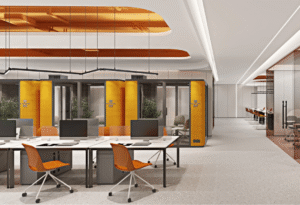
Understanding the Technical Scope of an Office Fit Out
Before a single floorboard is laid, it is essential to distinguish between the different “levels” of fit out. In the construction and commercial real estate sector, clarity on these definitions prevents scope creep and budgetary misalignment.
Categorizing Shell, Cat A, and Cat B Space?
Shell and Core: This is the building’s basic framework. It includes the structure, cladding, and base plant rooms, but lacks finished flooring, lighting, and internal partitioning.
Category A (Cat A): This involves the basic functional fit out of the tenant space. It typically includes raised floors, suspended ceilings, and basic mechanical and electrical (M&E) services. It is a “blank canvas” ready for customization.
Category B (Cat B): This is the focus of most planning guides. It transforms a Cat A space into a brand-specific environment, incorporating private offices, breakout areas, IT infrastructure, specialized lighting, and furniture.
A professional Fit Out Builder typically bridges the gap between these stages, ensuring that the physical limitations of the building structure do not conflict with the desired interior architecture.
Strategic Workplace Assessment and Data Analysis
The most common mistake in office planning is jumping straight into floor plans. An effective strategy begins with data.
How to Map Occupancy and Workflow?
Modern offices must accommodate hybrid work models. Planning should start with an occupancy audit: how many desks are actually used on peak days? Do teams require collaborative zones or quiet, acoustic-protected “pods”?
Analyze the “path of travel” within your current office. Engineering departments often require proximity to high-capacity data ports and specialized cooling, while HR departments require physical privacy and acoustic isolation for confidentiality. Mapping these adjacencies early informs the zoning of the new floor plate.
Site Selection and Technical Feasibility
Once the needs are identified, the focus shifts to the building’s technical capacity. Engaging a Fit Out Builder during the site selection phase can save significant costs by identifying hidden structural constraints.
Why Consult a Fit Out Builder During Site Selection?
| Technical Factor | Consideration for Planning |
| HVAC Capacity | Can the existing air conditioning handle the heat load of high-density server rooms or large boardrooms? |
| Floor Loading | For industrial-style offices or libraries, can the structural slab support the weight of heavy storage or machinery? |
| Power Distribution | Are there enough floor boxes or perimeter trunking points to support 1:1 desk ratios without tripping circuits? |
| Acoustic Rating | Does the building envelope provide enough sound attenuation from external traffic or neighboring tenants? |
Pre-Construction and Technical Coordination
While architects focus on the “vision,” the Fit Out Builder focuses on the “buildability.” During the planning phase, their role is to conduct a thorough technical due diligence.
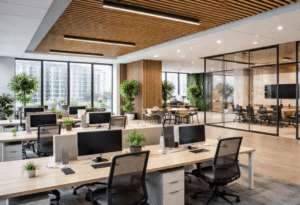
What is the Role of M&E Coordination in Planning?
M&E Coordination: Mechanical and Electrical systems are the nervous system of the office. A builder ensures that ductwork doesn’t clash with structural beams and that lighting layouts align with fire sprinkler positions.
Compliance and Building Control: Every commercial fit out must adhere to local building codes, fire safety regulations, and accessibility standards (such as the ADA or equivalent regional mandates).
Procurement Strategy: In a volatile global supply chain, planning must account for long-lead items. Specialized glass partitions, custom joinery, or high-end HVAC components may have lead times of 12–16 weeks.
Spatial Design, Zoning, and IT Infrastructure
Strategic zoning is about more than just placing furniture; it is about controlling environment variables.
Creating Effective Neighborhoods and Acoustic Buffers?
Instead of a monolithic open-plan space, modern fit outs utilize “neighborhoods.” Each zone is equipped with specific tools—standing desks for focus work, soft seating for informal catch-ups, and “war rooms” for intensive project sprints.
Acoustics are the most frequent complaint in modern offices. Effective planning incorporates:
Sound Absorption: Using Baffle ceilings or acoustic wall panels (Class A absorbers).
Sound Masking: Implementing “white noise” systems to reduce the radius of distraction in open-plan areas.
Acoustic Zoning: Placing noisy breakout areas far from “deep work” zones, separated by physical buffers like storage units or circulation corridors.
Integrating Future-Proof IT Infrastructure?
In a digital-first environment, the fit out is effectively a wrapper around the technology.
Server Room Specs: Ensure dedicated cooling (CRAC units) and fire suppression systems (such as FM-200 or Novec 1230) are planned early.
Cabling: Cat6a or Cat7 cabling is now the standard for future-proofing high-bandwidth requirements.
AV Integration: Video conferencing “friction” is a major productivity killer. Planning must include integrated AV in every meeting room, requiring early coordination between the Fit Out Builder and IT consultants to ensure power and data are exactly where the hardware needs them.
Sustainability and Wellness Standards
High-quality fit out planning now prioritizes the “S” and “G” in ESG (Environmental, Social, and Governance) criteria.
Applying ESG and Biophilic Design Principles?
Biophilic Design: Integrating natural light and indoor greenery isn’t just aesthetic; studies show it improves cognitive function by up to 15%.
Material Selection: Specify Low-VOC (Volatile Organic Compound) paints and sustainably sourced timber (FSC certified) to ensure indoor air quality.
Energy Efficiency: Transitioning to LED lighting with PIR (Passive Infrared) sensors and upgrading to smart BMS (Building Management Systems) can reduce operational energy costs by 30%.
Summary
Successful office fit out planning requires a balance between architectural vision and technical feasibility. By engaging a Fit Out Builder early, businesses can navigate the complexities of M&E coordination, building compliance, and procurement. Prioritizing data-driven occupancy analysis and sustainable design ensures that the final workspace is not only functional but also adaptable to future growth. Avoiding common pitfalls like ignoring “as-built” drawings or underestimating lead times is crucial for maintaining budget and schedule integrity.
FAQ
1. What is the difference between a fit out and renovation?
An office fit out involves taking a space that is structurally complete and making it habitable with partitions, flooring, and MEP services.
A renovation usually refers to updating an already occupied and finished space with cosmetic or structural changes.
2. How long does the planning phase typically take?
For a mid-sized office (10,000–20,000 sq. ft.), the planning and design phase typically takes 8–12 weeks.
This duration includes the technical audit, design iterations, and securing necessary building permits.
3. Why involves a builder during the design stage?
Involving a builder early ensures that the design is financially viable and technically feasible for the specific site.
They provide “real-time” costing and suggest alternative materials that offer the same performance at a lower price point.
4. What are the most critical compliance factors?
The primary concerns are fire life safety including unobstructed exit routes and smoke detection systems.
Other factors include ventilation rates for fresh air and accessibility compliance for doors, ramps, and bathrooms.
Reference Sources
BCO Guide to Specification for Modern Office Design
RICS Professional Statement on Commercial Dilapidations