

Why plan for a high-performance office
Planning a high-performance office in Perth requires decisions that balance employee wellbeing, energy use, long-term operating costs and flexibility for future change. A clear brief up front reduces rework, improves coordination between architects, services engineers and contractors, and helps align investment with workplace outcomes. Rather than treating energy or fit-out as add-ons, aim to integrate them into the brief so that architectural form, services and finishes support measurable performance targets. Where statutory approvals or classification questions arise, confirm requirements in the RFQ stage rather than assuming outcomes.
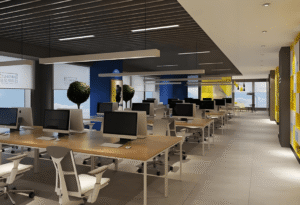
Key decision factors for choosing a Premier Office Builder
Site and location influence more than construction logistics; orientation, access to public transport, and neighbouring thermal mass can materially affect glazing strategy and HVAC sizing. Early site analysis lets the design team optimise façade treatments and shading, and it informs realistic occupancy scenarios. For any site-specific planning or classification matters, engage the project team early and confirm details as part of the RFQ so the builder prices known constraints rather than assuming them.
Workplace strategy and occupancy modelling
How you intend people to use the space will determine layout, acoustic treatment, power density and data requirements. Flexible workplaces that mix touchdown spaces, enclosed rooms and collaboration areas require different cabling, air distribution and access control strategies compared with cellular office models. Use occupancy modelling to size services and finishes: conservative overdesign raises capital and ongoing operating costs, while under-design creates retrofit risk. Define expected peak and typical occupancies in the brief and require RFQ confirmable assumptions from bidders.
Building fabric and thermal performance
Decisions about glazing ratios, insulation and external shading set the baseline for comfort and energy use. In Perth’s climate, control of solar gain and night-time cooling strategies can reduce mechanical loads. Selecting higher-performance glazing or deeper shading moves load from mechanical systems into passive design features, but it also affects daylight and views. Require suppliers to show predictive modelling for façade options, and include RFQ confirmation of modelling assumptions so comparative pricing is consistent.
HVAC, ventilation and indoor environment
Ventilation and cooling approaches must be sized and zoned to deliver comfort while minimising energy consumption. Recent guidance and the NCC energy-efficiency provisions provide options to test different system types and control strategies; include these considerations in tender documentation and ask bidders to show how proposed systems meet performance criteria [2]. Ensure the control strategy supports occupancy-based ventilation where appropriate and that acoustic, maintenance and access needs are considered in system selection rather than left until commissioning.
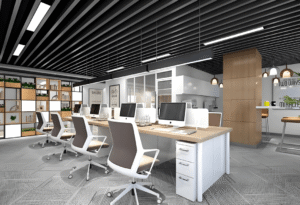
Lighting, controls and daylighting
Lighting affects both user wellbeing and electrical load. A combined approach using daylighting, efficient luminaires and smart controls can reduce energy while improving occupant satisfaction, but the balance depends on ceiling heights, façade transparency and internal partitions. Specify expected illuminance targets and control strategies in the brief, and require RFQ confirmation that tendered lighting proposals will meet those targets and integrate with BAS (building automation) systems.
Fit-out flexibility and finishes
Choosing finishes and modular systems that support future reconfiguration lowers lifecycle cost and business disruption. Raised floors, accessible ceilings and modular partition systems can allow relatively low-cost changes to power, data and acoustics. Require bidders to show how proposed finishes and partitioning systems will perform under typical reconfiguration scenarios, and make reconfiguration frequency and expectations a priced assumption in RFQs to avoid hidden future costs.
Materials, durability and maintenance
Specify materials that deliver the desired aesthetic and are aligned with an intended maintenance regime. Hardwearing finishes may cost more up front but reduce repair and replacement cycles; conversely, lower-cost finishes can increase operating workload. Include lifecycle maintenance expectations in the brief and ask tenderers to provide maintenance plans and warranty information as part of RFQ submissions so comparisons are made on equivalent bases.
Comparing procurement and delivery approaches
| Attribute | Design & Construct with integrated fit-out | Sequential construction then fit-out |
|---|---|---|
| Single point of responsibility | Higher — single contract can simplify coordination | Lower — separate contracts require careful management |
| Coordination risk | Lower if the team is experienced | Higher due to handover interface |
| Cost clarity at tender | Moderate — depends on design completeness at tender | High — fit-out priced to a clearer base building |
| Flexibility for late changes | Variable — changes can be cheaper within a single contract | Better for staged tenant-driven fit-outs |
| Ideal when | Brief is integrated and early coordination is critical | Base building needs separation or tenants require distinct timelines |
RFQ and selection checklist for a Premier Office Builder
- Demonstrated experience with comparable Perth office projects and evidence of team capability; request CVs and role definitions in the RFQ.
- Clear statement of assumed program and deliverables, with milestones that can be verified during tender evaluation.
- Design and construction approach showing how the builder will meet performance targets for thermal comfort, ventilation and lighting; require RFQ confirmation of modelling assumptions.
- Maintenance and lifecycle plan for major systems and finishes, including access and replacement strategies where relevant.
- Quality assurance, commissioning and post-occupancy testing approach, including how defects and performance gaps will be addressed.
- Risk allocation and proposed allowances for unknowns, with mechanisms to handle scope changes and coordination items.
- Evidence of supplier and subcontractor relationships likely to influence on-time delivery and product selections.
Budgeting, value engineering and lifecycle thinking
Value engineering should be framed as optimisation rather than cost cutting. Test alternatives that reduce operating expenditure or simplify maintenance, and require bidders to present trade-offs between capital and operating costs with clear assumptions. Avoid focusing exclusively on initial capital price; instead, ask for scenario modelling showing expected operating energy and maintenance commitments. Any energy-related modelling should reference national provisions and be confirmed during RFQ so bidders use consistent baselines [2].
Implementation, staging and minimising disruption
If works occur in an occupied building, staging and communication plans are critical. Specify acceptable hours, noise thresholds and security measures, and ask each tenderer to describe their site logistics and stakeholder engagement approach. Include verification steps for handover and post-occupancy adjustments so that the chosen builder commits to delivering not just a completed fit-out but a performance outcome measurable against the brief. For statutory approvals and classification advice, engage relevant authorities early and confirm expectations through the RFQ rather than assuming approval pathways [1].
FAQ
How early should a builder be involved in design?
Early builder involvement can reduce coordination cost and allow value engineering while the design is still flexible. A builder participating in design reviews helps to align construction sequencing, material choices and services coordination with the performance brief. If you choose to involve a contractor early, make sure their role and deliverables are clearly defined in the procurement documents and confirmed in the RFQ.
What performance metrics should be included in the brief?
Include measurable targets for thermal comfort, ventilation rates, illuminance and expected energy intensity so bidders can compare proposals on an equal footing. Specify how compliance will be demonstrated in commissioning and post-occupancy testing, and require RFQ responses to state assumptions behind predicted performance so you can evaluate realism and risk.
Can energy efficiency requirements be varied after contract award?
Major changes to energy-efficiency provisions after contract award can affect plant sizing, façade decisions and construction sequencing, which in turn change cost and time. Define desired efficiency levels in the tender and ask bidders to confirm how variations would be handled commercially. For guidance on energy-efficiency provisions in design and documentation, refer to national guidance and require RFQ-confirmed compliance strategies [2].
How do I verify a builder’s local capability?
Ask for evidence of recent Perth or WA projects, CVs for key personnel, and contactable references. Check the About page for a shortlisted contractor to verify their stated capabilities; for example, the About page describes Bene Build’s construction, fit-out and refurbishment approach and a prospective client should treat project scope as requiring RFQ confirmation. Also require RFQ confirmation of licence and regulatory status where relevant to the project.
Ready to discuss how these decision points apply to your project? For a non-obligatory conversation or to request detailed RFQ documentation, see Bene Build’s project enquiry page.
References
WA Building and Energy — Building approvals (Accessed 19 August 2026)
Australian Building Codes Board — NCC Tutor: Using the energy efficiency provisions in Volume One (Accessed 19 August 2026)