

The Perth commercial landscape is undergoing a significant transformation in 2026. For businesses planning an office refurbishment in Perth, creating sustainable, employee-focused, and technology-enabled workplaces has become a strategic priority. A well-planned Perth office refurbishment can reduce operating costs, improve workplace productivity, and help attract top talent in an increasingly competitive market.
Modern refurbishments are no longer just about new carpets and a coat of paint; they involve complex structural adaptations, technology integration, and a deep understanding of human-centric design. Property owners and facility managers are increasingly looking for ways to future-proof their assets against evolving market demands and more stringent regulatory requirements. This shift is particularly evident in the high-vacancy areas where older “B” and “C” grade buildings are being aggressively upgraded to compete with new premium developments.
Evolutionary Shifts in Perth’s Commercial Refurbishment
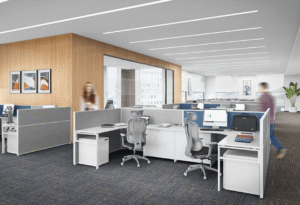
The most prominent trend in the Perth market is the move toward hybrid-ready environments. Businesses are no longer seeking maximum desk density. Instead, they are prioritizing “destination offices”—spaces that offer amenities and collaborative environments that employees cannot replicate at home. This evolution requires a fundamental rethink of floor plate utilization and internal traffic flow.
The Transition to Agile Workspace Design
This shift often involves a transition from traditional Category A fit-outs to more bespoke Category B designs. Key elements include:
Hot-Desking Hubs: Integrated with smart booking systems to manage fluctuating daily occupancy.
Acoustic Privacy Pods: Providing quiet zones for video conferencing in otherwise open-plan layouts.
Breakout Social Zones: Designing “third spaces” that encourage spontaneous collaboration and social cohesion.
Modular Partitioning: Allowing for the rapid reconfiguration of meeting rooms as team sizes change.
In Perth, where the lifestyle often emphasizes a work-life balance, these spaces frequently incorporate “end-of-trip” facilities. High-quality showers, secure bike storage, and locker rooms are now standard requirements for any high-tier refurbishment project seeking to attract premium tenants.
Sustainability and ESG Benchmarks in Western Australia
Environmental, Social, and Governance (ESG) criteria are driving a massive wave of refurbishments across Western Australia. National Australian Built Environment Rating System (NABERS) ratings are now a primary concern for investors. Retrofitting an existing building is often more sustainable than a new build, as it preserves the “embodied carbon” of the original structure while drastically reducing operational carbon through modernized systems.
| Feature | Traditional Refurbishment | Modern Sustainable Refurbishment |
| Lighting | Standard Fluorescent/LED | IoT-controlled Smart LED with Daylight Harvesting |
| HVAC | Centralized VAV Systems | Zoned VRF Systems with Heat Recovery |
| Materials | Standard Commercial Grade | Low-VOC, Recycled, and Carbon-Neutral Certified |
| Water | Standard Fixtures | High-efficiency WELS-rated fittings |
| Energy Monitoring | Manual Metering | Real-time Cloud-based Analytics |
Meeting NABERS and Green Star Standards
In the context of the Perth climate, cooling efficiency is paramount. Refurbishments now frequently include the installation of high-performance glazing and thermal insulation to reduce solar gain, directly lowering long-term operational costs and improving Green Star ratings. Engineers are increasingly specifying Phase Change Materials (PCMs) and high-thermal-mass elements to stabilize internal temperatures during Perth’s intense summer peaks.
Biophilic Design and Employee Wellbeing
Biophilic design—the practice of connecting occupants to the natural environment—has seen a surge in popularity in Perth’s commercial sector. Given WA’s unique flora and abundant natural light, designers are increasingly blurring the lines between indoor and outdoor spaces to combat “sick building syndrome” and enhance mental clarity.
Integrating WA Native Landscapes
This trend manifests in several ways:
Internal Green Walls: Using native WA plant species to improve air quality and provide visual relief.
Natural Material Palettes: Incorporating timber, stone, and earthy textures that reflect the local landscape, from the coastal limestone to the iron-rich Pilbara tones.
Circadian Lighting: Implementing smart lighting systems that mimic the natural movement of the sun, supporting the biological clocks of employees who spend long hours indoors.
Outdoor Connectivity: Maximizing views of the Swan River or Kings Park and creating usable balcony or terrace workspaces.
Research consistently shows that biophilic elements can reduce stress levels and increase productivity, making it a functional choice rather than a purely decorative one.
Technical Infrastructure and Smart Building Integration
A modern commercial refurbishment in Perth is incomplete without a robust digital backbone. “Smart buildings” utilize a network of sensors and data analytics to optimize building performance in real-time. This level of integration requires early-stage collaboration between architects, electrical engineers, and IT consultants.
Engineers and project managers are now integrating:
Occupancy Sensors: To automate lighting and climate control based on real-time room usage.
Contactless Technology: From entry points to kitchen facilities, reducing touchpoints in high-traffic areas.
Universal Power Access: Moving away from fixed floor boxes toward flexible, modular power distribution systems that allow for easy furniture reconfiguration.
5G and Fiber Reinforcement: Ensuring zero-latency connectivity throughout the floorplate, including traditionally “dead” zones like elevators and basements.
Adaptive Reuse of Perth’s Industrial Heritage
Perth has a wealth of mid-century and industrial buildings in areas like Northbridge and Fremantle that are ripe for adaptive reuse. Converting older warehouses or dated office blocks into modern, creative hubs is a major sub-trend within the commercial refurbishment sector.
This process requires a deep understanding of the Building Code of Australia (BCA) and Disability Discrimination Act (DDA) compliance. Refurbishing older structures often necessitates:
Structural Strengthening: To support modern heavy-duty plant equipment or additional floor loads.
Accessibility Upgrades: Including the installation of compliant ramps, lifts, and tactile indicators.
Service Modernization: Completely stripping out antiquated electrical and plumbing systems to accommodate high-speed fiber optics and modern fire safety standards.
Acoustic Retrofitting: Enhancing sound insulation between floors and external facades to meet modern privacy and comfort standards.
Summary
Successful commercial refurbishment in Perth requires a holistic approach that balances aesthetic appeal with technical performance and regulatory compliance. By focusing on hybrid flexibility, ESG standards, and smart technology, property owners can significantly increase asset value and tenant satisfaction. As the Perth market continues to mature, those who invest in high-quality, sustainable, and employee-focused refurbishments will remain at the forefront of the Western Australian business landscape.
FAQ
1. What is the difference between a fit-out and a refurbishment?
A fit-out typically refers to the initial process of making an interior space suitable for occupation, often starting from a “warm shell.” A refurbishment is the broader process of renovating, improving, or updating an existing space that is already occupied or has been previously fitted out, often involving structural or systemic changes.
2. How does the Perth climate affect material selection?
The high UV index and summer heat in Perth necessitate a focus on thermal performance and UV resistance. Materials must be selected based on their thermal mass and ability to withstand intense solar exposure. This includes specifying high-spec insulation and UV-filtering window films to protect interior finishes from fading.
3. Is planning permission required for internal changes?
In many cases, minor internal cosmetic changes do not require a full development application. However, if the refurbishment involves structural changes, changes to the building’s use, or impacts on heritage elements, approvals from the local council and a Building Permit from a registered building surveyor are mandatory in Western Australia.
4. What are the mandatory end-of-trip facility requirements?
While specific requirements vary by building grade, the City of Perth often mandates a certain ratio of showers, lockers, and secure bicycle parking based on the total net lettable area (NLA). These facilities are essential for achieving high NABERS and Green Star ratings and are critical for modern tenant attraction strategies.
5. How long does a typical CBD refurbishment project take?
Timelines vary significantly based on scale and complexity. A minor office refresh may take 4–8 weeks, while a full-scale structural refurbishment of a multi-storey building can take 6–12 months. This timeline must account for the design phase, council approvals, procurement of long-lead items, and the actual construction period.
Reference Sources
Green Building Council of Australia: Green Star Standards
Australian Building Codes Board: National Construction Code