

Deciding between an office and commercial fit out depends on your business goals and operational needs. Both processes involve transforming a shell into a functional workspace. However, the design requirements and technical standards vary significantly.
In Australia, businesses often confuse these two terms during the early planning stages. An office fit out focuses on productivity, ergonomics, and corporate identity. Conversely, a commercial fit out serves broader industries like retail, hospitality, or healthcare.
Selecting the wrong approach can lead to budget overruns or compliance issues. Understanding the nuances of each helps you allocate resources effectively. This guide explores the distinct characteristics, costs, and regulatory frameworks for both options.
What is the Difference Between Office and Commercial Fit Out?
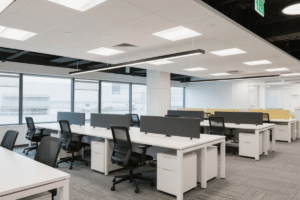
The primary difference lies in the end-user interaction and the specific activities performed within the space. An office fit out creates an environment for internal staff to complete administrative or creative tasks. These projects prioritize acoustics, lighting, and seamless technology integration.
A commercial fit out covers spaces designed for public interaction and specialized service delivery. This includes retail stores, restaurants, gyms, and medical clinics. These environments require high durability to withstand heavy foot traffic and unique brand experiences.
| Feature | Office Fit Out | Commercial Fit Out |
| Primary Goal | Employee productivity and focus | Customer experience and sales |
| Key Priority | Ergonomics and connectivity | Flow, branding, and accessibility |
| Typical Lifespan | 7–10 years | 3–5 years (Retail/Hospitality) |
| Complexity | Moderate technical needs | High technical/specialized needs |
Data from Australian industry benchmarks shows that commercial spaces often require higher initial investment. For instance, hospitality fit outs can cost 40% more per square metre than standard corporate offices. This is due to specialized plumbing, ventilation, and grease traps.
Defining User Requirements in Australia
In an office and commercial fit out, user requirements dictate the floor plan. Office users need quiet zones and collaborative hubs to maintain a steady workflow. These spaces often use modular furniture to accommodate changing team sizes.
Commercial users, particularly in retail, focus on the “customer journey” and product placement. Lighting must highlight specific areas to drive sales and engagement. The durability of materials is also much higher to handle thousands of visitors weekly.
How to Plan Your Office and Commercial Fit Out Budget
Budgeting is the most critical phase of any Australian property project. Costs vary based on the “Class” of the building under National Construction Code (NCC) standards. You must account for design fees, approvals, and physical construction costs.
For a standard office fit out, prices in Sydney or Melbourne typically range from $800 to $1,800 per square metre. Higher-end legal or financial firms may exceed $2,500 per square metre. These costs include workstations, partitions, and breakout zones.
Breakdown of Specialized Commercial Costs
Commercial projects follow a different cost structure due to bespoke equipment. A retail fit out might range from $1,500 to $3,500 per square metre. Restaurant fit outs are the most expensive, often reaching $4,000 per square metre for kitchen installations.
Design and management fees usually account for 10% to 15% of the total budget. Council and approval fees can range from $5,000 to $20,000 depending on the scope. Always set aside a 10% contingency fund for unforeseen structural issues.
Key Compliance Factors for Australian Workspaces
Every office and commercial fit out must comply with Australian Standards (AS). This ensures the safety of employees and the general public. Failure to meet these standards can result in heavy fines or forced closures.
Accessibility is a major requirement under the Disability Discrimination Act (DDA). This affects door widths, ramp gradients, and tactile ground surface indicators. Commercial retail spaces must ensure that all customers can navigate the store without assistance.
Safety and Environmental Regulations
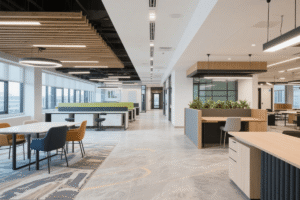
Fire safety is another non-negotiable element. You must install smoke detectors, fire extinguishers, and emergency exit signs. Office spaces often use open-plan layouts to simplify exit routes, while retail spaces must ensure shelving does not block sprinklers.
Proper ventilation and air quality are now top priorities post-pandemic. Commercial buildings must meet AS 1668.2 standards for mechanical ventilation. This is critical for gyms and salons where chemicals or physical exertion affect air purity.
Choosing the Right Fit Out for Your Business Needs
Determining whether you need an office or commercial fit out starts with your business model. Ask yourself if your primary revenue comes from walk-in customers. If the answer is yes, you are likely planning a commercial project.
If your team focuses on digital services or internal collaboration, an office layout is best. You should focus on creating a “home away from home” atmosphere. This attracts top talent in the competitive Australian job market.
Future-Proofing Your Investment
Modern office and commercial fit out trends favor modular furniture and adaptable zones. This allows your business to scale up or down without requiring a full renovation. Flexibility ensures your investment remains viable as your business grows.
Analyze your lease agreement before starting any construction work. Most Australian commercial leases require “make good” clauses. This means you must return the space to its original state when the lease expires.
How to Identify the Best Workspace Solution
Identifying the right solution requires a balance of aesthetics and functionality. You must determine if your space needs to be a “high-performance” engine or a “high-impact” showroom. This choice dictates every design decision from floor finishes to lighting.
Successful office and commercial fit out projects rely on a clear project brief. This document should outline your headcount, technology needs, and brand values. A well-defined brief prevents “scope creep” which often inflates project timelines.
Sustainable Practices in Fit Out Projects
Consider the environmental impact of your fit out. Australian businesses are increasingly seeking Green Star ratings for their interiors. Using sustainable materials can reduce long-term energy costs by up to 30% through better efficiency.
Working with a local expert ensures that your project meets specific state regulations. NSW, VIC, and QLD have slightly different planning permit processes. A qualified project manager will navigate these local hurdles on your behalf.
Summary
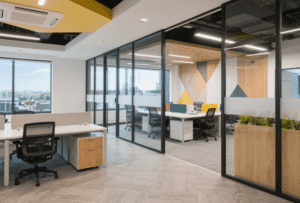
An office fit out prioritizes internal workflow and employee comfort, while a commercial fit out focuses on public interaction and industry-specific functions. Understanding these differences allows Australian business owners to budget accurately, ensure legal compliance, and create spaces that drive long-term commercial success and operational efficiency.
FAQ
1. What is the average timeline for an office fit out?
Most projects take 8 to 14 weeks from initial design to completion. This includes time for council approvals and specialized material lead times.
2. Do I need a building permit for a commercial fit out?
Yes, most fit outs require a Complying Development Certificate (CDC) or a Development Application (DA). This ensures the structural and fire safety changes meet local Australian regulations.
3. Can I reuse existing furniture in a new fit out?
You can reuse furniture to save costs, but it must fit the new layout. Integrated data and power points in old desks may not align with new floor boxes.
4. What is a “Shell and Core” fit out?
This refers to a space that is delivered with only the basic structure and services. The tenant is responsible for adding ceilings, floors, and internal walls during the office and commercial fit out phase.
Reference Sources
Master Builders Australia: Industry cost benchmarks and best practices for commercial construction.
Safe Work Australia: Workplace health and safety requirements for Australian business environments.