

The Perth commercial landscape is undergoing a significant transformation. As Western Australia’s economy remains resilient, driven by the resources sector and a growing professional services hub, the demand for high-quality, sustainable, and employee-centric workspaces has reached a decade-high. For facility managers, asset owners, and business leaders, an office refurbishment in Perth is no longer just a cosmetic upgrade; it is a strategic maneuver to mitigate rising operational costs and secure top-tier talent in a competitive labor market.
Successfully executing a refurbishment in the current Perth climate requires a deep understanding of local supply chain constraints, the National Construction Code (NCC) 2022 updates, and the specific structural requirements of CBD and suburban office assets.
The Shift Toward “Flight to Quality” in Perth CBD
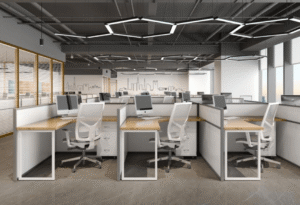
Perth is currently witnessing a “flight to quality.” Tenants are vacating secondary grade assets in favor of A-grade and Premium spaces that offer superior energy ratings and wellness amenities. For owners of B-grade assets, refurbishment is the primary tool to prevent obsolescence.
The focus has shifted from high-density desking to “destination offices.” This involves creating spaces that offer what the home office cannot: advanced conferencing technology, collaborative “third spaces,” and premium end-of-trip (EOT) facilities. In Perth, where the return-to-office rates are among the highest in Australia, the physical environment must justify the commute.
Key Trends Shaping Perth Office Refurbishments
1. Decarbonization and ESG Compliance
Sustainability is no longer optional. With the City of Perth’s commitment to carbon neutrality, refurbishments are increasingly judged on their NABERS (National Australian Built Environment Rating System) and Green Star performance.
Mechanical Upgrades: Replacing outdated HVAC systems with high-efficiency VRF (Variable Refrigerant Flow) systems.
Material Circularity: Reusing existing partitions and furniture to reduce embodied carbon, a practice becoming standard in Perth’s “warm shell” handovers.
2. Adaptive Hybrid Layouts
The 1:1 desk-to-employee ratio is effectively obsolete in Perth’s professional sectors. Modern refurbishments prioritize:
Quiet Zones: Acoustically treated pods for deep work.
Collaborative Hubs: Flexible furniture configurations that allow for rapid reconfiguration.
Tech-Integrated Boardrooms: Seamless AV integration to support hybrid meetings with remote sites in the Pilbara or international time zones.
3. Industrial-Chic and Biophilic Design
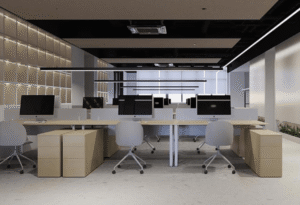
Reflecting WA’s unique landscape, there is a strong trend toward using local materials—raw timbers, stone, and indoor greenery. This biophilic approach is proven to improve cognitive function and reduce stress, a key selling point for Perth’s mining and engineering firms.
Technical Specifications: Defining the Scope
When initiating an office refurbishment in Perth, stakeholders must distinguish between different levels of fit-out and refurbishment to align budgets with project goals.
| Refurbishment Type | Typical Scope | Best For |
| Decorative Refresh | Painting, new flooring, updated lighting, and furniture. | Short-term lease extensions (2–3 years). |
| Category B Fit-out | New internal walls, kitchenettes, power/data distribution, and branding. | New tenants moving into a “warm shell.” |
| Comprehensive Refit | Structural changes, HVAC overhaul, ceiling grid replacement, and EOT upgrades. | Asset repositioning or long-term HQ commitments. |
Procurement and Cost Drivers in the WA Market
The Perth construction industry faces unique challenges, primarily regarding labor availability and specialized material lead times. Understanding these commercial realities is essential for accurate RFQ (Request for Quote) evaluations.
Cost Estimations and Budgeting
While costs vary based on finishes, a standard high-quality office refurbishment in Perth typically ranges from $1,200 to $2,000+ per square meter.
Labor: Competition for trades with the residential sector and large-scale mining projects can inflate site costs.
Logistics: Many high-end fixtures and specialized glazing are shipped from the Eastern States or overseas, necessitating a 12-to-16-week lead time buffer.
Compliance and Certifications
Every refurbishment must adhere to the Building Code of Australia (BCA) and AS1428.1 (Design for Access and Mobility). In Perth, the Development Approval (DA) process through local councils or the State Development Assessment Unit (SDAU) can impact timelines. Engaging a specialized building certifier early in the design phase is critical to avoid costly mid-construction modifications.
Strategic RFQ Workflow for Decision Makers
For organizations ready to move forward, following a structured procurement process ensures transparency and mitigates risk:
Needs Assessment: Define headcount projections and functional requirements for the next 5–7 years.
Dilapidation Survey: Conduct a thorough audit of the existing mechanical, electrical, and plumbing (MEP) services. In older Perth buildings, this often reveals hidden costs related to seismic bracing or asbestos.
Shortlisting Contractors: Select 3–4 Perth-based contractors with proven experience in commercial office environments. Request case studies specifically focused on “live environment” works if the office will remain occupied.
Tender Evaluation: Look beyond the bottom-line figure. Evaluate the proposed project manager’s experience, the robustness of the safety management system (WHS), and the clarity of the site program (timeline).
Long-Lead Item Procurement: Order HVAC components, specialized joinery, and workstations immediately upon contract signing to prevent handover delays.
Managing Project Timelines in Perth
A standard 500sqm office refurbishment in Perth generally follows this timeline:
Design & Documentation: 4–6 weeks.
Permitting (Building Permit): 2–4 weeks (parallel to procurement).
Construction Phase: 8–12 weeks.
Defects Liability Period: Usually 12 months post-completion.
Conclusion
An office refurbishment in Perth is a high-stakes investment that requires a balance of aesthetic vision and technical pragmatism. By prioritizing ESG standards, adapting to hybrid work requirements, and navigating the local labor market with a clear procurement strategy, Perth businesses can transform their physical workspace into a high-performing asset. The goal is to create an environment that not only facilitates work but actively enhances the culture and productivity of the organization.
FAQ
Q: Can we remain in the office during a refurbishment?
A: Yes, this is known as a “staged” or “live environment” refurbishment. It requires careful coordination, often involving noisy works being performed after hours (typically after 6:00 PM) to minimize disruption to staff.
Q: What is the typical lead time for office furniture in Perth?
A: For Australian-made workstations, expect 4–6 weeks. However, high-end ergonomic seating or imported European furniture can take 12–18 weeks depending on shipping schedules to Fremantle Port.
Q: Does a refurbishment require a new Building Permit?
A: Generally, yes. Any modification that affects the building’s layout, fire safety systems, or structural integrity requires a building permit from the local government (e.g., City of Perth, City of Stirling).
Q: How does the NCC 2022 affect my office refurbishment?
A: The most significant impacts are in Section J (Energy Efficiency). New refurbishments must often meet stricter requirements for insulation, glazing performance, and lighting power density to reduce the building’s overall carbon footprint.
Q: What are the current MOQs (Minimum Order Quantities) for custom office joinery?
A: Most Perth-based commercial joiners do not set strict MOQs for project-based work, but price efficiency is significantly better when ordering modular units or consistent finishes across larger floorplates.
Reference Sources
Master Builders Western Australia (MBWA): Industry standards and labor market updates for the WA construction sector.
Green Building Council of Australia (GBCA): Information on Green Star ratings for fit-outs.
Australian Building Codes Board (ABCB): Access to the National Construction Code (NCC) 2022.
NABERS: Guidelines for energy and water efficiency in office environments.
City of Perth – Planning and Development: Local requirements for commercial building permits and heritage considerations.